If you ride a train through Switzerland, there’s a moment when daylight vanishes, your ears gently pop, and your own reflection drifts across the window glass. For most commuters, it barely registers. It’s the stretch where you check messages, sip coffee, think about dinner.
What’s easy to miss is that you’re moving through one of the most ambitious climate and environmental projects on Earth.

Read Also- Day will turn to night: the century’s longest solar eclipse now has an official date
Beneath your seat is a second Switzerland—carved into rock over decades, engineered not just for speed or comfort, but to quietly solve a problem most countries still argue about.
A Second Country Hidden Under the Mountains
Switzerland has dug more than 1,400 tunnels into its landscape. Added together, tunnels and galleries stretch over 2,000 kilometers underground. That includes rail tunnels beneath the Alps, road tunnels threading national highways, and hidden passages for water and power.

In sheer scale, this underground network rivals the transit systems of the world’s biggest cities.
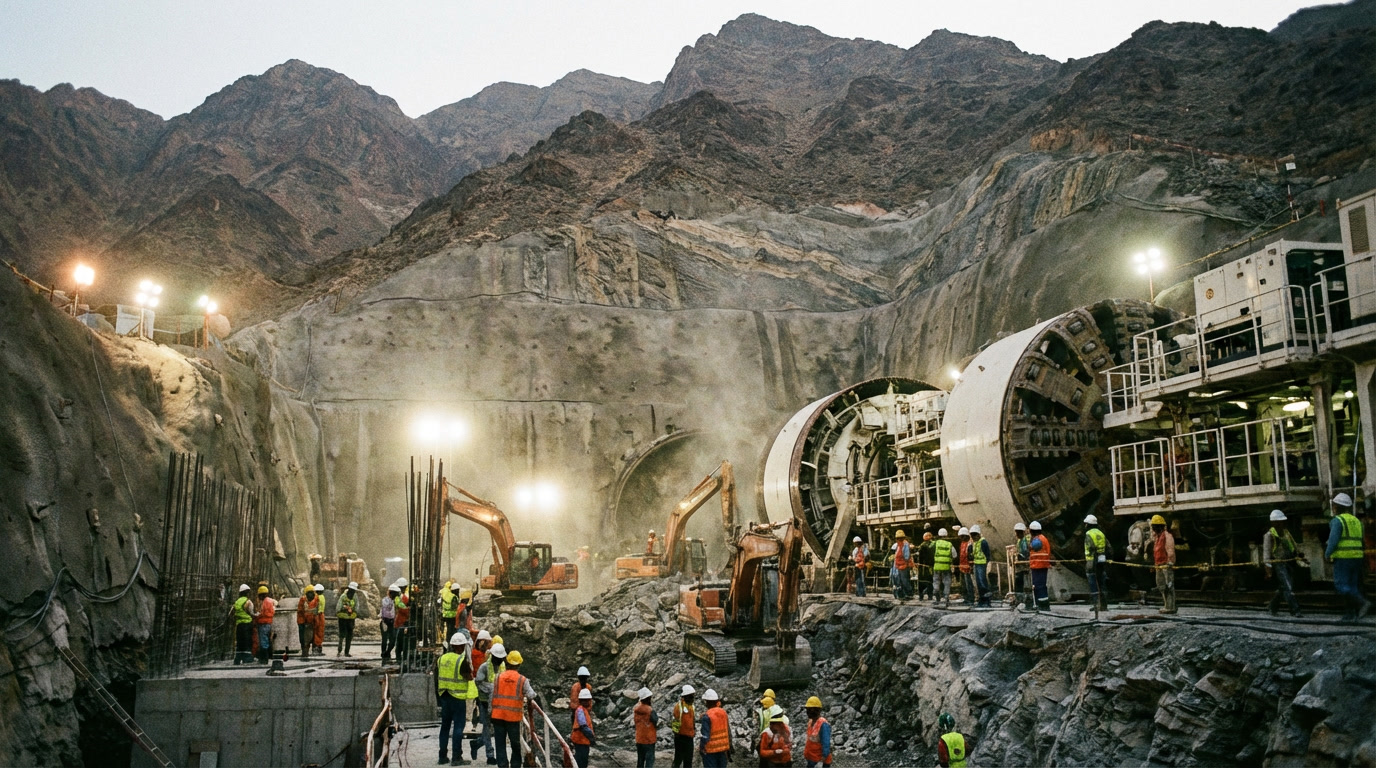
The crown jewel is the New Rail Link through the Alps, known locally as the NRLA. It connects three massive base tunnels—Lötschberg, Gotthard, and Ceneri—into a flat rail corridor straight through the mountains. The Gotthard Base Tunnel alone runs about 57 kilometers, making it the longest railway tunnel on Earth. Passenger trains cross it in roughly 20 minutes, a journey that once meant climbing and descending endless curves.
From the outside, it looks like a convenience upgrade. Faster trips. Fewer traffic jams. Less white-knuckle driving behind trucks on mountain passes.
But the real reason Switzerland spent decades and billions digging through granite is environmental.
The Swiss government openly describes the NRLA as a tool to “shift freight traffic from road to rail in order to protect the Alps,” a goal backed by national votes and embedded into law.
Why Trains Matter More Than Trucks in the Alps
Before the tunnels, Alpine valleys carried a steady roar of heavy trucks. Diesel fumes hung in narrow villages. Summer heat trapped pollution between steep slopes. Accident risks climbed with every extra lorry inching through hairpin roads.
In the 1990s, Swiss voters approved the Alpine Initiative, a political commitment to move long-distance freight off roads and onto rail.
The tunnels are what made that promise physically possible.
A flat rail route under the mountains allows longer, heavier freight trains that burn far less energy than trucks grinding uphill. Across Europe, freight rail typically uses about one-fifth of the energy and emits roughly one-quarter of the greenhouse gases per tonne-kilometer compared with heavy road transport.
Switzerland reinforced that advantage with policy. A distance-based heavy vehicle fee makes long truck journeys expensive, while rail infrastructure was expanded and modernized.
The results are rare in climate policy: measurable and sustained.
Today, more than 72 percent of cross-Alpine freight in Switzerland moves by rail. In 2018, about 941,000 trucks crossed the Swiss Alps—roughly one-third fewer than in 2000. Without this modal shift, analysts estimate that more than 650,000 additional trucks would have crossed the Alps in 2016 alone, and around 0.7 million tonnes of CO₂ were avoided in 2017 compared with business-as-usual projections.
Even now, officials admit the work isn’t finished. In 2022, roughly 880,000 lorry journeys still crossed the Alps, well above long-standing political targets. But the curve has bent—and stayed bent.
For people living in Alpine valleys, the difference is tangible. Fewer trucks mean quieter nights, cleaner summer air, and safer roads when you pull out of a side street.
Digging Deep Without Destroying the Surface
Let’s be honest: drilling through mountains is not carbon-free.
The Gotthard Base Tunnel alone required excavating around 28 million tonnes of rock and pouring vast amounts of concrete. That embodied footprint matters. Switzerland never pretended otherwise.
What it did do was try to limit the damage.
Official environmental reports describe how more than 150 kilometers of shafts and passages were excavated while minimizing surface impact. Excavated material was moved by rail or ship where possible. Construction machinery used particle filters. Wastewater was treated and cooled before entering rivers.
Communities near construction sites weren’t ignored. Noise barriers were built from stockpiled topsoil. Roads were regularly cleaned. Once construction ended, riverbanks were restored, streams reshaped into more natural channels, and dry-stone walls rebuilt to support reptiles and small wildlife.
The guiding idea was simple: if you take from the mountain, you give something back.
There’s also a climate-adaptation angle many people overlook. Deep tunnels and avalanche galleries already protect transport routes from snow slides and rockfalls. As extreme rainfall events increase with warming temperatures, buried infrastructure can keep rail and road links open when surface routes are flooded or unstable.
Why Switzerland Could Pull This Off
This underground country didn’t appear by accident.
Swiss voters backed long-term goals decades ago. Engineers planned routes patiently. Financing was stabilized through a dedicated federal rail fund that stretches beyond election cycles.
That combination—public buy-in, technical planning, and guaranteed funding—is rare.
For countries wrestling with highway congestion, air pollution, and rising freight emissions, the Swiss lesson is clear but uncomfortable: tunnels alone are not a climate solution.
They only work when paired with pricing that reflects environmental costs, strong rail investment, and rules that actually push freight operators toward cleaner choices. Without those, tunnels become expensive shortcuts, not systemic change.
The Quiet Power of Reliability
Back on the train platform, all of this feels abstract. You notice the train arrived on time. It’s quiet. It’s warm. It works.
That ordinariness is the point.
Reliable, boring infrastructure is what gives people the confidence to leave cars at home, companies the confidence to ship goods by rail, and governments the credibility to enforce climate policy without sparking backlash.
Switzerland didn’t shout its climate strategy. It drilled it—meter by meter—under the mountains.
And every time the lights dim and daylight disappears outside your window, you’re briefly traveling through that decision.
FAQs:
Why does Switzerland build so many tunnels?
Its mountainous geography makes surface routes difficult, but tunnels also reduce environmental damage, improve safety, and support rail over road transport.
What is the Gotthard Base Tunnel used for?
Both passenger and freight trains. It allows fast, flat travel through the Alps, making rail competitive with trucking.
Do tunnels really help reduce emissions?
Yes, when combined with policies that shift freight from road to rail. Rail transport emits significantly less CO₂ per tonne-kilometer than trucks.