The first time you see one of China’s artificial islands from the air, it doesn’t look like geopolitics.
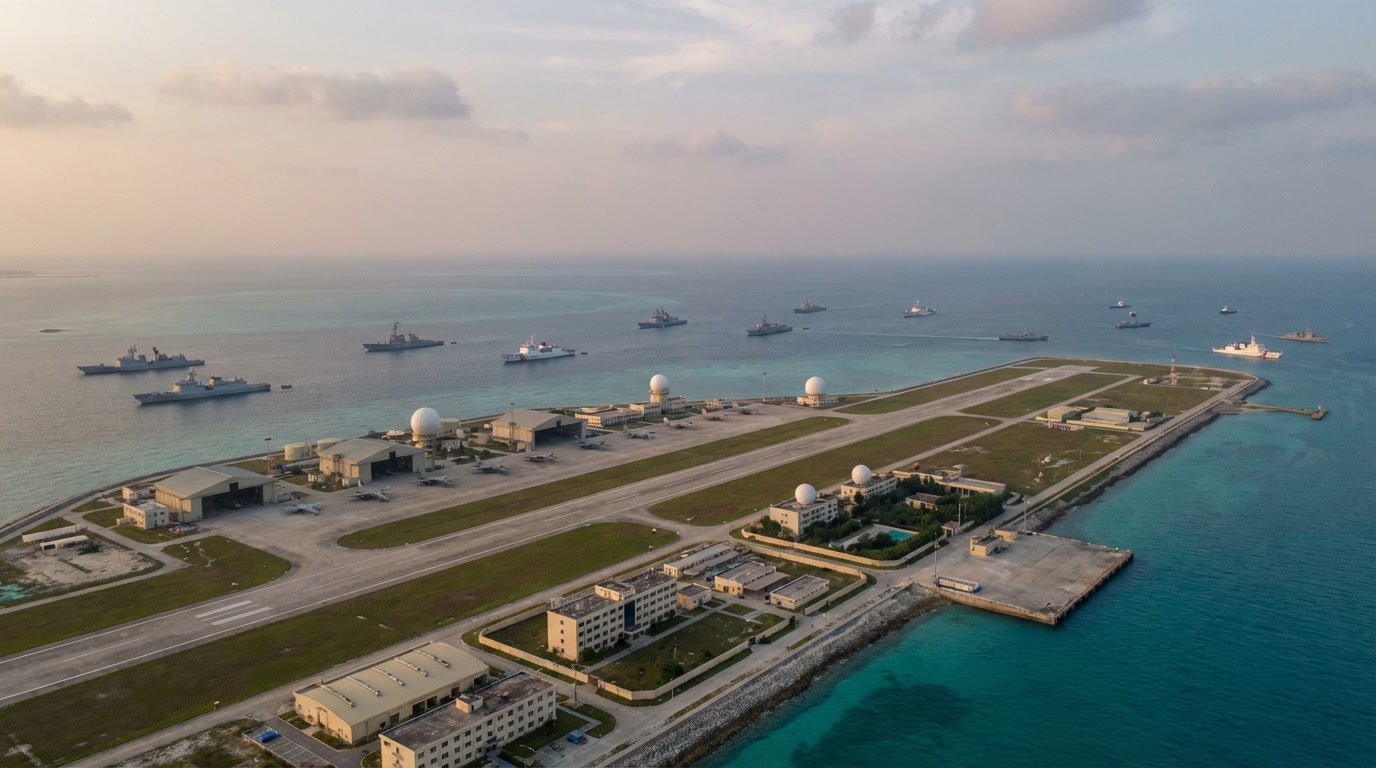
It looks like a glitch in the ocean. A ruler-straight runway carved into turquoise water. Cranes frozen mid-swing. A faint gray ring of warships hovering nearby like punctuation marks.
Pilots talk about them the way they talk about turbulence. Fishermen in the Philippines describe strange lights on the horizon that didn’t exist when they were kids. Meanwhile, the rest of the world scrolls, argues, and moves on.

Out there, dredgers keep working. Sand pumps hum through the night. Radar domes rise. Runways stretch.
Read Also- Buried under 2 km of Antarctic ice, scientists discover a lost world 34 million years old
What’s being built isn’t just concrete.
It’s a quiet rewrite of who gets to set the rules.
Islands That Shift Power Without Moving Borders

From satellite images, China’s outposts in the South China Sea look permanent, inevitable. Reefs that once vanished at high tide now host runways long enough for military aircraft, deep-water harbors, missile shelters, and layered radar systems.
Just ten years ago, most of these features were barely coral smudges on navigation charts. Today, they are staffed, fortified, and wired into China’s military network. According to analysis by the Center for Strategic and International Studies (https://www.csis.org), several islands now support full-spectrum military operations.
Here’s the clever part: no official border has moved.
On paper, the South China Sea is still governed by international law. The United Nations Convention on the Law of the Sea (UNCLOS) still exists. The 2016 ruling by the Permanent Court of Arbitration in The Hague rejected China’s sweeping “nine-dash line” claims (https://pca-cpa.org).
China simply ignored it.
At sea, fishermen feel the difference immediately. Vietnamese and Filipino crews talk about loudspeaker warnings from Chinese coast guard ships, water cannons blasting wooden hulls, lasers aimed at bridges. One Filipino captain near Scarborough Shoal said his grandfather fished there freely. Now they’re warned off long before land is visible.
Nothing changed on the map. Everything changed on the water.
Presence beats paperwork. A gray hull enforcing rules every day feels more real than any ruling stored in an archive in Europe.
How Sand Turns Claims Into Control
Beijing’s island-building strategy isn’t loud. It’s procedural.
Runways extend reach. Radars extend vision. Harbors extend supply lines. Together, they transform disputed waters into something that behaves like sovereign territory—even if no one else officially recognizes it.
International law moves at the speed of meetings, statements, and diplomatic notes. Dredgers work 24/7.
That imbalance matters.
Every additional structure normalizes the idea that these islands are permanent facts. Over time, shipping routes adjust, insurance premiums shift, naval patrols recalibrate. What was once controversial becomes routine.
Power doesn’t always arrive with an announcement. Sometimes it arrives with concrete.
From Reefs to Rules: Exporting the Same Playbook
The South China Sea isn’t an exception. It’s a template.
If you zoom out, the pattern repeats across ports, railways, cables, and digital infrastructure worldwide. Follow the money. Then follow the data.
Chinese-backed projects stretch from Gwadar in Pakistan to Hambantota in Sri Lanka, from Piraeus in Greece to ports along Africa’s Atlantic coast. First comes infrastructure: loans, engineers, cranes. Then come contracts, security arrangements, and digital systems that are difficult to disentangle later.
Hambantota remains the cautionary tale. Sri Lanka borrowed heavily to build a port that struggled to generate revenue. When repayments became unmanageable, the government leased the port to a Chinese company for 99 years. Officially commercial. Strategically unmistakable.
The World Bank (https://www.worldbank.org) and IMF (https://www.imf.org) have both flagged how infrastructure debt can reshape national policy choices long after ribbon cuttings fade.
We’ve all felt this dynamic personally. A small compromise years ago that quietly limits your options today.
Digital Infrastructure Is the New Island
The same logic now applies to cables and code.
Telecom networks built by Huawei. Smart-city systems routing data through Chinese servers. E-payment platforms that dominate local economies. Cloud contracts that define where data lives and who can access it.
Each decision looks technical, even boring. Then a political crisis hits.
A government considers criticizing Beijing on Taiwan, Xinjiang, or maritime disputes. Someone in the room asks the uncomfortable question: what happens to our port lease, our telecom network, our data access if we do?
No missile needs to launch. Leverage already exists.
This is why U.S. and European policymakers increasingly talk about “strategic dependencies.” The European Commission (https://commission.europa.eu) and the U.S. Department of Defense (https://www.defense.gov) now openly warn that infrastructure and security are inseparable.
What Other Countries Can Still Do—If They’re Honest
Late awakenings breed dramatic speeches. But speeches don’t counter slow, physical power.
The more effective response is procedural too.
Some countries now screen infrastructure projects not just for economic value, but for strategic risk. Japan and several EU states treat ports, undersea cables, and cloud systems as national-security assets, not just investments.
The harder challenge is emotional. Chinese financing often arrives faster and with fewer lectures than Western alternatives. Leaders facing elections want roads now, jobs now, growth now.
So they promise themselves they’ll “diversify later.”
Later rarely comes.
Admitting dependence feels humiliating. But pretending geopolitics stops at the shoreline is worse. The same logic shaping reefs in the South China Sea is shaping rail lines, data flows, and satellite partnerships.
A Southeast Asian diplomat put it bluntly: “China isn’t just claiming islands. It’s claiming the rules of how things work. Every year we delay, the baseline shifts.”
The Bigger Question Behind the Islands
Look again at those artificial islands. They’re symbols, yes—but they’re also tools.
They influence how navies plan, how traders price risk, how neighboring governments calculate what’s “too provocative” to say out loud. They send a message: while others debate norms, Beijing builds facts.
The deeper question isn’t really about China. It’s about everyone else.
What kind of world forms when slow, unglamorous projects shape freedom more than elections? When sand pumped onto a reef can influence fuel prices, shipping insurance, and supply chains thousands of miles away?
Some countries are responding with their own infrastructure funds, digital alliances, and tougher screening rules. Others hope the storm will pass if they don’t look directly at it.
The islands will keep growing regardless.
So will the cables, the data centers, the satellite constellations.
The real map being redrawn isn’t just geographic. It’s about who quietly writes the rules everyone else wakes up to find already in place.
FAQs:
Is China’s island-building legal under international law?
No. A 2016 ruling by the Permanent Court of Arbitration rejected China’s claims. Beijing rejected the ruling and relies instead on physical presence.
Can these islands function as military bases?
Yes. Many host long runways, hangars, radar systems, and missile platforms suitable for sustained military operations.
Why should people outside Asia care?
About one-third of global maritime trade passes through the South China Sea. Control there affects fuel prices, supply chains, and economic stability worldwide.