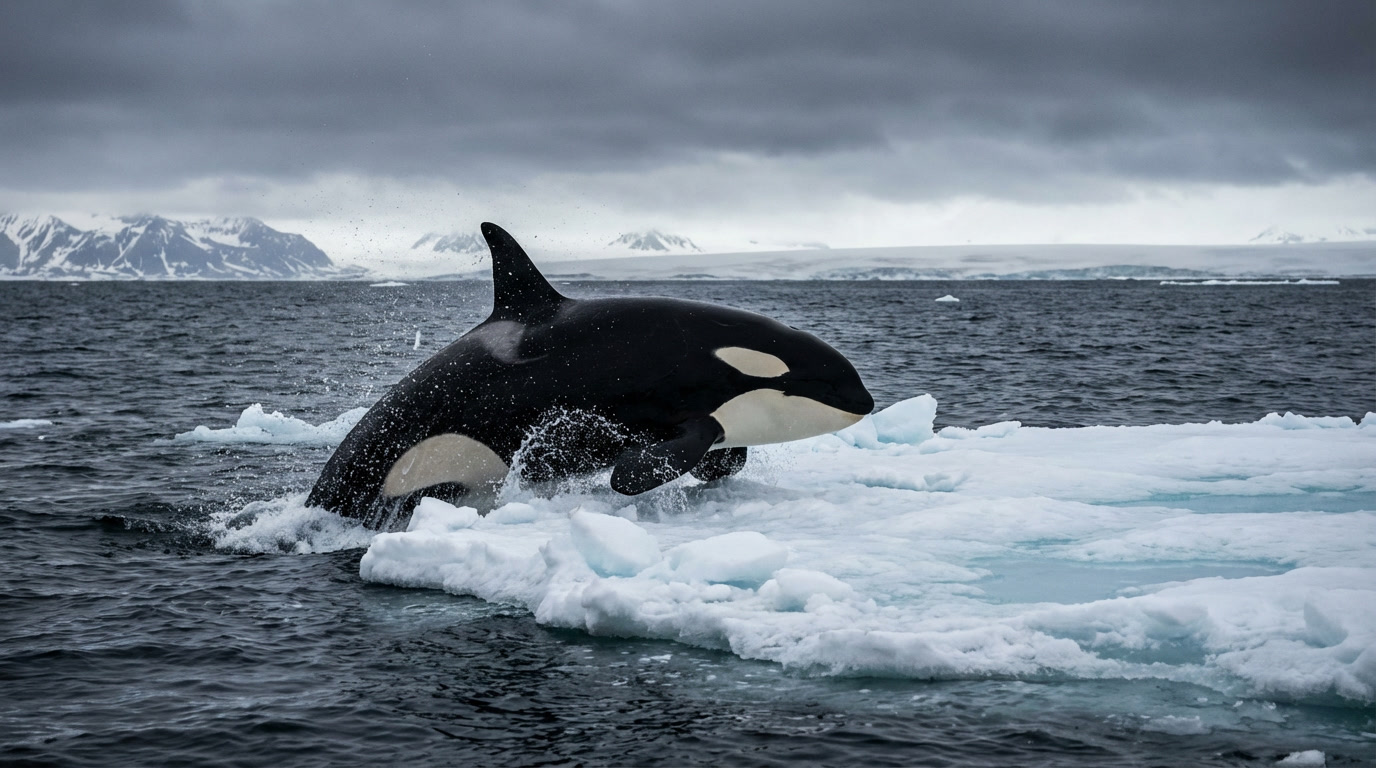
Orcas were spotted breaching beside ice that, just a few years ago, would have been sealed shut in thick, unbroken white. For the researchers watching from their boats, the moment was both thrilling and deeply unsettling. The sea was calm. The ice was not.
From the deck, massive blue-white walls of ice could be seen thinning and slumping, dripping steadily into the dark water below. The orcas cut through the surface with sharp exhalations, their dorsal fins slicing clean arcs against a landscape that no longer behaved the way it used to. Cameras came up, drones lifted, voices lowered. Someone finally said the word that had been hanging in the air.

Collapse.
Orcas at the edge of a changing world
At first glance, the orcas looked as if they were playing. Sleek black bodies, white eye patches flashing, tails rolling lazily through the water. But the GPS data told a different story. Their movements traced the jagged edge of a rapidly retreating ice shelf, looping again and again along melt lines that shift from week to week.
“They’re using the ice edge like a hunting ground,” one marine biologist said quietly.

This behavior would have been nearly impossible a few decades ago. Thick pack ice once blocked access to these interior zones for most of the year. As warming temperatures thin and fracture that ice, new corridors of open water are appearing. For highly intelligent, adaptable predators like orcas, those openings represent opportunity.
But that opportunity is built on instability.
Satellite records show summer sea-ice thickness in some Arctic regions has dropped by more than 40 percent in just a few decades. What once appeared as a solid white cap on maps is now fragmented and fragile. When orcas first appeared in these newly accessible areas, scientists thought the sightings might be anomalies. They weren’t.

Acoustic sensors now pick up orca hunting calls near calving glaciers. Drone footage shows repeated breaches close to unstable ice faces. In one Greenland fjord, researchers were forced to move their boats after ice began collapsing nearby, blurring the line between wildlife observation and emergency response.
What these sightings really signal
Orcas are not the problem. They are responding exactly as evolution trained them to: by exploiting new conditions. The concern lies in what their presence reveals.
As ice retreats, orcas move into territories once dominated by species like polar bears and ice-dependent seals. That shift alters food webs that took thousands of years to form. Prey species face new pressures at the same time their habitats are shrinking. The ecosystem begins to rearrange itself, fast.
This is not a controlled transition. It is a scramble.
Scientists worry not because orcas are “winning,” but because rapid change leaves little time for balance. Apex predators adjusting quickly is a sign that the system itself is under stress. What benefits one species in the short term can destabilize many others, including the predators themselves, as prey populations fluctuate or decline.
Why this matters beyond the poles
For people far from icy coastlines, orcas hunting near collapsing glaciers can feel like distant drama. But the forces driving those scenes are the same ones shaping everyday life elsewhere.
Warmer air melts ice. Less ice reflects less sunlight. Darker oceans absorb more heat, accelerating warming in a feedback loop that affects global weather patterns. That loop influences rising sea levels, stronger storms, disrupted fisheries, higher food prices, and increasing insurance costs.
Climate change is not an abstract concept playing out “somewhere else.” It is a chain reaction. The orca at the ice edge is simply one of its most visible messengers.
What actually helps now
The scale of the problem can feel paralysing, which is why many people disengage. But meaningful climate action rarely comes from perfection. It comes from consistency.
Focusing on one area of life at a time makes change manageable. Transportation choices, food habits, home energy use, or even where money is invested — small, sustained shifts compound over time. Much like interest, they grow quietly, then noticeably.
Equally important is staying engaged rather than looking away. Scientists working in polar regions often say the hardest part is not the cold or the danger, but the fear that what they are witnessing will be ignored.
A warning, not an ending
Eventually, the pod moved on. The last dorsal fin disappeared beneath the surface, leaving only ripples and the distant sound of ice breaking apart. The researchers stayed on deck longer than necessary, staring at a landscape that no longer matched their old field guides.
This is not yet a finished story. Some damage is already locked in, but there remains a vast difference between a future that is worse and one that is catastrophic. The space between those outcomes is shaped by choices — political, cultural, and personal — made year after year.
When orcas hunt along melt lines that did not exist a generation ago, they are adapting in real time. The question is not whether nature will respond to change. It already is.
The real question is whether we will.
FAQs:
Why are orcas being seen near melting ice more often?
Orcas are accessing areas that were previously blocked by thick sea ice. As the ice thins and retreats due to warming temperatures, new hunting grounds are opening up.
Are orcas responsible for the damage to polar ice ecosystems?
No. Orcas are not causing the ice to melt. Their behavior is a response to climate-driven changes already underway, not the source of those changes.
Why are scientists alarmed by orcas hunting near ice edges?
Because it signals how quickly polar environments are changing. Orcas entering these zones shows that long-standing ecological barriers are breaking down, reshaping entire food webs.