For a few minutes, the world did something it almost never does. Daytime switched off.
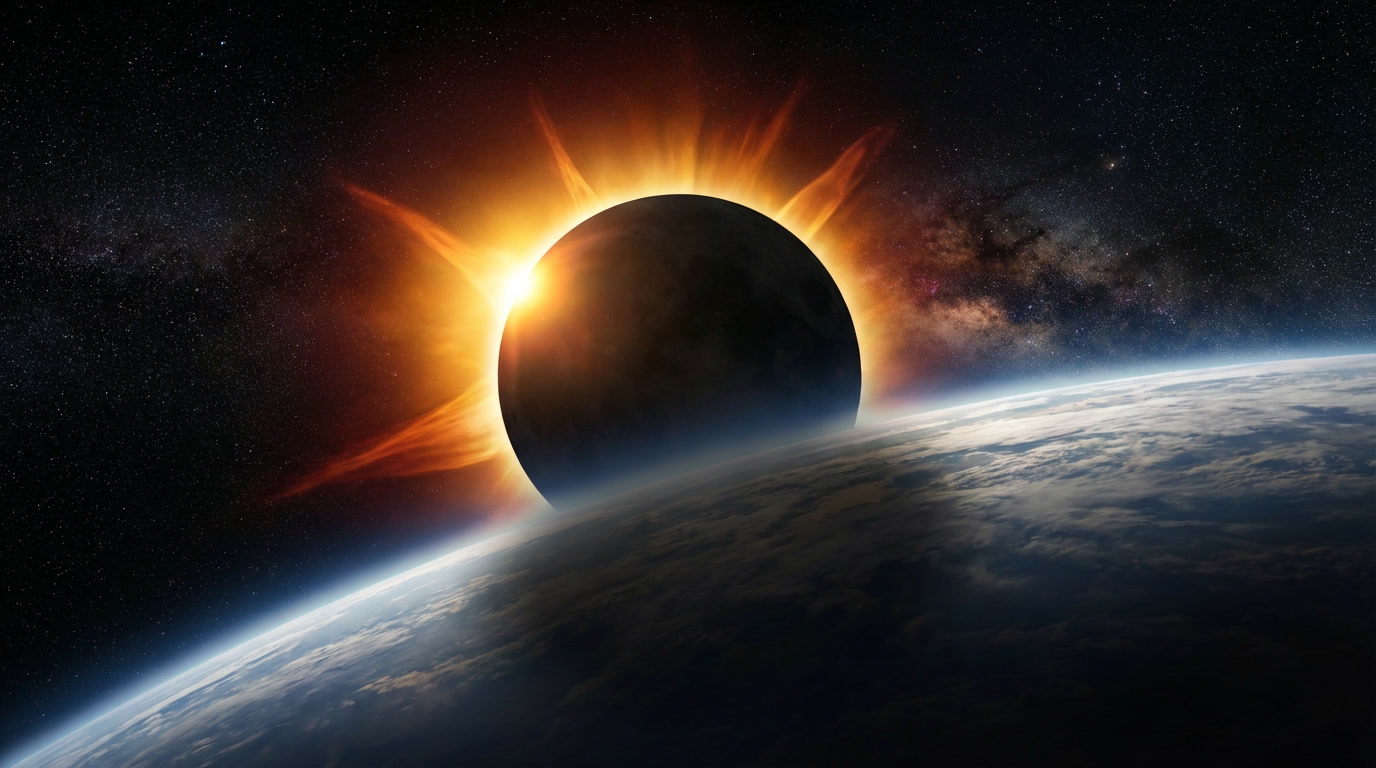
The sky dimmed into an eerie twilight. Temperatures dropped fast enough to notice. Birds fell silent. Stars appeared where the Sun had ruled moments earlier. Across large stretches of Asia and the Pacific, millions of people stood still as the Moon locked perfectly into place, blotting out the Sun longer than anyone alive would ever see again.

Astronomers weren’t exaggerating when they called it the “Eclipse of the Century.” This wasn’t just another celestial event. It was the longest total solar eclipse of the 21st century—a cosmic alignment so precise it brushed against the physical limits of what’s possible on Earth.
When the Eclipse of the Century happened
The date is now fixed in astronomical history: 22 July 2009.
On that day, the Moon’s shadow carved a long, slow path across Earth, delivering a maximum totality of about 6 minutes and 39 seconds. To put that in perspective, most total solar eclipses barely last two to three minutes. Many feel over before your brain has fully registered what’s happening.
This one lingered.
NASA scientists described it as “the most prolonged period of totality humans will experience in the 2000s,” a statement backed by orbital mathematics, not hype.
Why this eclipse lasted so long
Solar eclipses aren’t rare, but long eclipses are. Duration depends on a fragile balance of cosmic factors, and on 22 July 2009, they aligned almost perfectly.

Here’s why this one stretched so far beyond the norm:
- The Moon was unusually close to Earth, appearing slightly larger in the sky
- The Earth was farther from the Sun, making the Sun appear marginally smaller
- The eclipse path crossed near the equator, where Earth’s rotation slows the Moon’s shadow
- The alignment between Sun, Moon, and Earth was nearly flawless
When all of this happens at once, the Moon doesn’t just cover the Sun—it lingers there, holding daylight hostage.
Where the world went dark
The path of totality swept across some of the most densely populated regions on the planet, turning this into a shared human experience rather than a remote spectacle.
Areas that experienced full totality included:
- India
- Bangladesh
- Myanmar
- Large parts of China
- Sections of the Pacific Ocean
Tens of millions stood directly beneath the Moon’s umbra, while hundreds of millions more witnessed dramatic partial phases that turned midday into a dim, metallic dusk.
What six minutes of darkness actually feels like
Short eclipses feel like a trick. Blink and you miss it. This one was different.
Observers described a slow, unmistakable transition:
- Sunlight faded like a stretched-out sunset
- Temperatures dropped several degrees
- Birds stopped singing; insects went quiet
- Stars and planets appeared overhead
- The Sun’s corona glowed vividly around the black disk
An astronomer working with the European Space Agency noted that the extended darkness “gave both people and nature time to react, which is rare and deeply unsettling.” The pause was long enough to feel real—not symbolic.
Voices from beneath the shadow
In eastern China, factory worker Zhang Wei remembered the moment clearly. “It felt like evening arrived all at once. Everyone stopped working and just stared upward.”
In India, schoolteacher Anjali Mehta described how quickly the environment changed. “Dogs lay down. Birds stopped flying. The air felt cooler. The children went completely silent.”
These reactions weren’t imagination. During longer eclipses, animals often respond as if night has arrived—because for several minutes, biologically speaking, it has.
Why scientists call it a once-in-a-century event
Total solar eclipses occur somewhere on Earth roughly every 18 months. But that statistic hides the real rarity.
Here’s how the odds break down:
| Event type | How often it happens |
|---|---|
| Any total solar eclipse | Every ~18 months |
| Total eclipse over the same location | Every 300–400 years |
| Total eclipse lasting over 6 minutes | A few times per millennium |
| Comparable event after 2009 | Not until after 2100 |
That combination—extreme duration, populated viewing regions, and favorable conditions—won’t repeat within this century. For modern humanity, this was it.
Why those extra minutes mattered to science
For solar physicists, six minutes of totality isn’t just dramatic—it’s priceless.
During total eclipses, scientists can study the Sun’s corona without specialized instruments. The longer the darkness, the more data they can gather.
During the 2009 eclipse, researchers were able to:
- Observe the Sun’s outer atmosphere in detail
- Study solar magnetic field structures
- Test space weather models
- Improve understanding of solar plasma dynamics
A solar physicist involved in the observations explained that many experiments are simply impossible during short eclipses. This one gave them breathing room.
Typical eclipse vs. the Eclipse of the Century
| Feature | Typical total eclipse | Eclipse of the Century |
|---|---|---|
| Totality duration | 2–3 minutes | ~6 minutes 39 seconds |
| Darkness | Brief twilight | Sustained near-night |
| Scientific value | Limited | Exceptional |
| Rarity | Relatively common | Extremely rare |
| Next similar event | Decades away | Beyond this century |
What people should know about viewing eclipses
Astronomers repeatedly stress one thing: eye safety matters.
Key reminders:
- Use certified eclipse glasses before and after totality
- Never look directly at the Sun outside full totality
- Naked-eye viewing is safe only during complete coverage
- Position yourself carefully within the path of totality
For those brief minutes when the Sun is fully blocked, it’s safe to look—but timing is everything.
Why this eclipse captured the world’s attention
The 2009 eclipse wasn’t just a scientific milestone. It became a collective pause. Schools stopped lessons. Cities slowed. Millions of people—across borders, languages, and beliefs—looked up at the same sky.
An astronomy educator summed it up simply: “It reminded people that the universe still has the power to surprise us.”
For a few minutes, human schedules didn’t matter. Only orbital mechanics did.
FAQs:
What was the Eclipse of the Century?
The longest total solar eclipse of the 21st century.
How long did totality last?
Up to about 6 minutes and 39 seconds at maximum.
When did it occur?
22 July 2009.