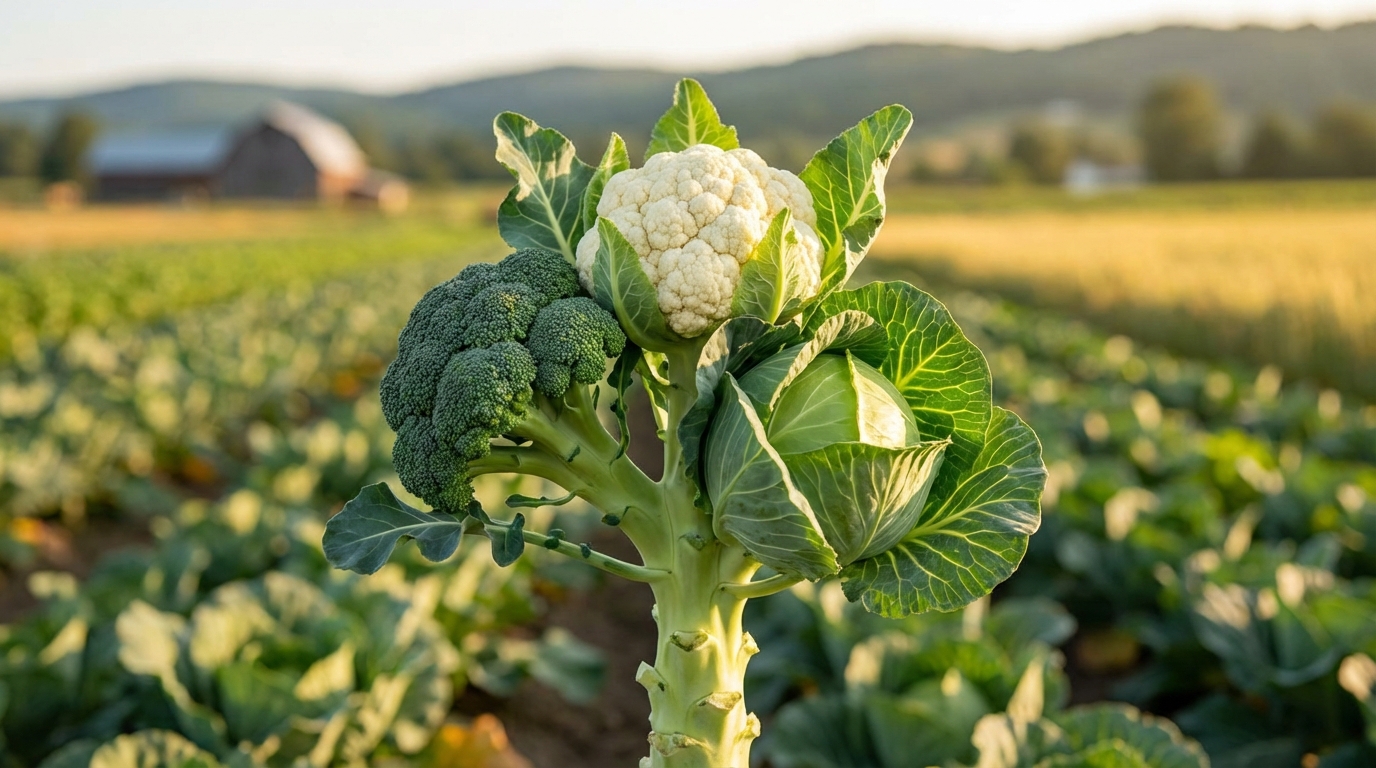
Most people treat cauliflower, broccoli, and cabbage as entirely different vegetables, each with its own place in the kitchen. Botanically, however, they are all expressions of the same plant species, shaped over centuries by human preference and farming practices. What looks like variety is actually a remarkable story of selective cultivation.
One Species, Many Vegetables
Cauliflower, broccoli, cabbage, kale, and Brussels sprouts all belong to a single species known as Brassica oleracea. Despite their differences in shape, colour, and taste, they share the same genetic origin.

The wild ancestor of these vegetables grew along rocky coastal cliffs of the Mediterranean and Atlantic regions of Europe. This original plant was hardy, tolerant of salty winds, and relatively simple in appearance. Over time, farmers noticed small natural variations—larger leaves, thicker stems, or denser buds—and began saving seeds from plants with desirable traits.
Generation after generation, these choices reshaped the plant into multiple vegetables, each emphasising a different edible part.
How Selective Breeding Changed the Plant
The differences between cauliflower, broccoli, and cabbage come down to which part of the plant humans encouraged to grow.

Broccoli and cauliflower are both grown for their flower structures. Broccoli develops branching green stems topped with clusters of small, tight flower buds. Cauliflower, on the other hand, forms a dense, compact head of undeveloped flower buds that remain pale because they are protected from sunlight by surrounding leaves.
Cabbage followed a different path. Instead of flowers, its tightly wrapped leaves became the focus. The inward-curling leaves form the familiar round head that stores well and survives transport, making cabbage a staple food across many cultures.
Kale represents yet another variation, where loose, open leaves are harvested without forming a head at all.
From Ancient Diets to Modern Plates

Historical records suggest that early forms of Brassica oleracea were eaten by ancient Greek and Egyptian societies, mainly as leafy greens. By the third century BCE, farmers in regions now part of Italy were actively cultivating the plant.
During the Middle Ages, kale-like varieties were among the most common vegetables in Europe due to their resilience in cold climates. Later, Italian growers refined broccoli and cauliflower, selecting plants with increasingly distinct flower structures.
By the time modern agriculture emerged, these vegetables were already well-established as separate foods, despite sharing the same botanical identity.
Growing Conditions and Farming Preferences
Although they look different, most Brassica oleracea vegetables prefer similar growing conditions.
| Factor | Preferred Conditions |
|---|---|
| Climate | Cool to mild temperatures |
| Soil | Fertile, well-drained, rich in organic matter |
| Water | Regular moisture without waterlogging |
| Tolerance | Handles light frost better than extreme heat |
Gardeners often rotate these crops to prevent soil-borne diseases and maintain soil health. Some varieties, such as ornamental kale, are grown purely for visual appeal rather than food.
Nutritional Value of Cauliflower
Cauliflower is often overshadowed by broccoli in nutrition discussions, but it offers significant health benefits. It is low in calories and high in vitamins C, K, and B9 (folate), along with minerals such as potassium, calcium, and phosphorus.
Its fibre supports digestion and gut health, while plant compounds like glucosinolates and polyphenols are linked to protective effects against inflammation and oxidative stress. Cauliflower also contains vitamin C, which helps improve iron absorption from plant-based foods.
For pregnant women, its folate content is especially important, as folate supports early development of the baby’s nervous system.
How These Vegetables Are Used in Cooking
One reason Brassica oleracea vegetables remain popular is their versatility. Cauliflower can be eaten raw, roasted, steamed, mashed, or blended into soups. It is often used as a low-carb substitute for rice or potatoes.
Broccoli works well in stir-fries, salads, and pasta dishes, while cabbage appears in soups, slaws, fermented foods, and stuffed recipes. Kale is widely used in smoothies, sautés, and baked snacks.
Because these vegetables are closely related, they can often be substituted for one another in recipes with minimal adjustment.
A Single Plant, Endless Possibilities
When viewed together, cauliflower, broccoli, cabbage, kale, and Brussels sprouts stop looking like unrelated foods and start to resemble members of the same family—each adapted for a different purpose.
Their diversity is not the result of nature alone, but of centuries of human choice, patience, and agricultural experimentation. From wild coastal plants to modern dinner plates, Brassica oleracea stands as one of the clearest examples of how humans and plants have evolved together.
FAQs:
Are cauliflower, broccoli, and cabbage the same species?
Yes. Cauliflower, broccoli, cabbage, kale, and Brussels sprouts all belong to the same species, Brassica oleracea. Their differences come from selective breeding, not from different plant origins.
Why do these vegetables look so different if they are the same species?
Farmers selected different plant traits over centuries. Cauliflower and broccoli were bred for their flower buds, while cabbage was bred for tightly packed leaves, creating very different shapes and uses.
What part of the plant is eaten in cauliflower?
Cauliflower is eaten for its immature flower buds, which form a dense, compact head protected by surrounding leaves.