For nearly two centuries, the Galápagos Islands have been treated like a biological time capsule—a place where evolution paused for inspection. Now, that same archipelago is quietly becoming something else entirely: a live experiment in repairing broken ecosystems using animals themselves, not machines, fences, or concrete.
At the center of this shift is a creature once thought of as slow, passive, and symbolic. The giant tortoise is no longer just a conservation icon. It’s become working infrastructure.
How the giants vanished from their own islands

When Charles Darwin arrived in the Galápagos in 1835, giant tortoises weren’t rare curiosities. They were everywhere—and they shaped everything. These massive reptiles grazed shrubs, flattened pathways, fertilized soil, and transported seeds across kilometers of rugged terrain. Entire plant communities evolved around their movements.
Read Also- Daylight Saving Time 2026 – Clocks Will Fall Back Sooner This Year
Then humans arrived with ships and appetites.

Sailors harvested tortoises as living food stores. Later came egg collection, habitat destruction, and invasive animals like goats and pigs. By the mid-20th century, tortoises had vanished from several islands entirely. Others clung to survival in small, isolated pockets.
What followed wasn’t just the loss of a species. It was the slow breakdown of ecological processes.
Without large herbivores, woody plants thickened. Invasive shrubs swallowed open ground. Trees and cacti that depended on large animals for seed dispersal stopped spreading. According to ecological reconstructions supported by the Galápagos National Park Directorate, the islands remained “green,” but functionally altered.

For roughly 150 years, Galápagos ecosystems ran without one of their core engines.
Rebuilding ecosystems with living animals
The turnaround began in the 1990s. Instead of restoring habitats with machinery, conservationists focused on restoring function.
The Galápagos National Park, working with the Galapagos Conservancy and international researchers, launched one of the largest reptile recovery programs ever attempted. Breeding centers raised hatchlings from the few remaining purebred tortoises, along with genetically valuable hybrids identified through decades of research.
Between the 1990s and 2020, more than 1,500 giant tortoises were reintroduced to islands including Española, Santa Fé, Pinzón, and parts of Santa Cruz. Animals were transported by boat, truck, and helicopter—sometimes slung carefully beneath aircraft.
But the goal was never just to boost numbers.
It was to restart ecological machinery that had been offline for generations, a strategy outlined in conservation frameworks published by organizations like the International Union for Conservation of Nature.
How tortoises reshape the landscape without trying
Giant tortoises don’t manage land intentionally. They just eat, walk, rest, and repeat. But their size turns ordinary behavior into landscape-scale change.
As they move, tortoises:
Reduce dominance of invasive shrubs
Prevent thickets from sealing off open ground
Maintain corridors used by birds, reptiles, and insects
Repeatedly trample young woody plants before they mature
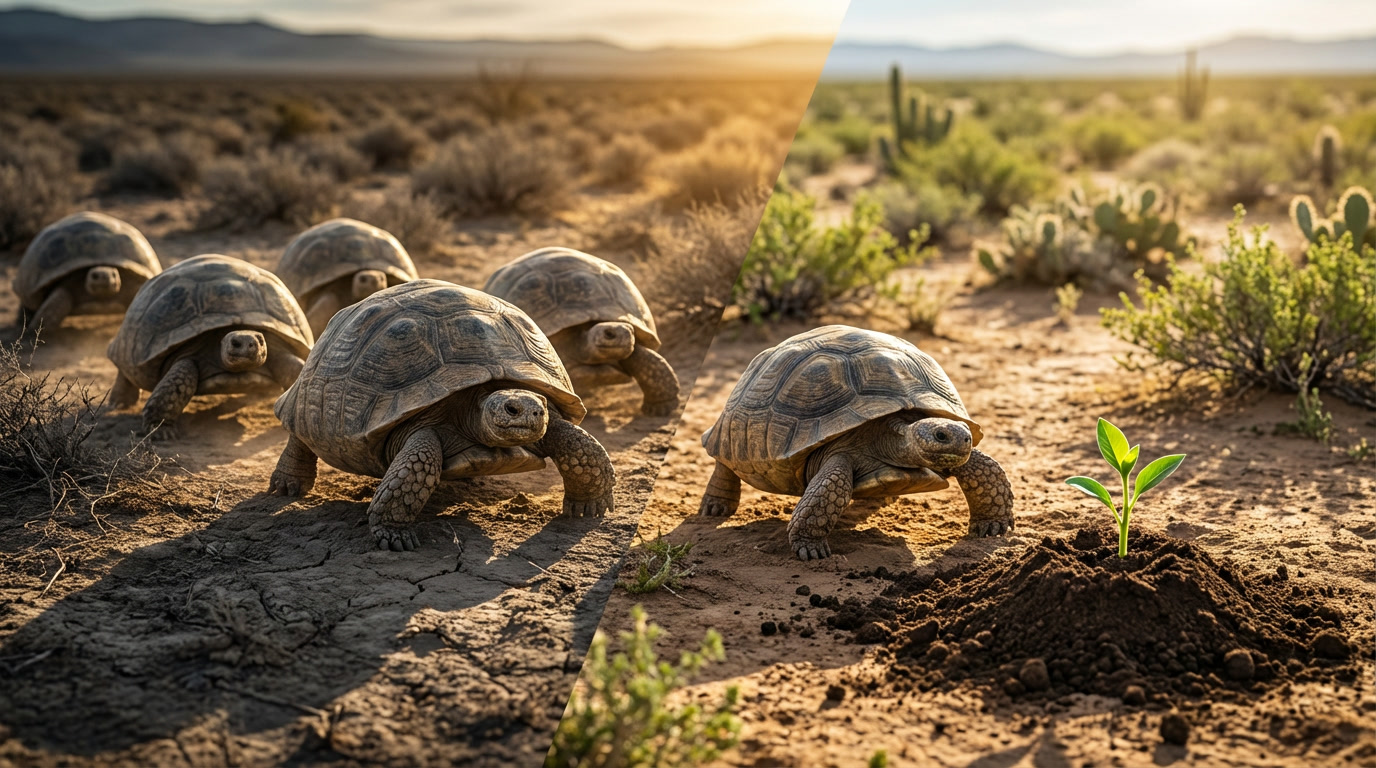
On Española Island, where invasive plants once formed near-continuous walls of vegetation, drone imagery and ground surveys now show a patchwork of clearings and clusters. This structure closely matches descriptions from early naturalists and ship logs, referenced in ecological assessments supported by UNESCO’s Galápagos World Heritage documentation.
What would otherwise require mechanical clearing crews is now handled by animals that never clock out.
Seed dispersal, tortoise-style
One of the most dramatic changes happens invisibly—inside a tortoise’s gut.
Giant tortoises swallow fruits whole. Seeds survive digestion and are deposited kilometers away, wrapped in nutrient-rich dung. Field studies show seeds can travel 3 to 5 kilometers from their parent plant, far beyond the range of birds or wind.
Plants benefiting from this revival include:
Opuntia cacti
Piscidia carthagenensis trees
Scalesia, the iconic “daisy trees” of Galápagos
In areas of Santa Cruz where botanists hadn’t recorded new seedlings in years, young plants are now appearing along tortoise trails. Soil sampling confirms restored dispersal networks—an ecological service long thought irretrievable.
Ecosystem engineers in slow motion
Ecologists now classify Galápagos tortoises as ecosystem engineers, a term reserved for species that physically reshape habitats for others. Think beavers building wetlands or elephants shaping savannas.
Tortoises:
Convert dense scrub into mosaics of open ground and shelter
Create micro-habitats for insects and ground-nesting birds
Expose soil that favors fast-growing native plants
Weaken the competitive edge of shade-tolerant invasive species
Over time, aerial surveys reveal a shift from monotonous brush to structurally diverse landscapes. Finch species, insect-eating birds, and endemic reptiles respond quickly to this renewed complexity.
Before and after: what actually changed
Long-term monitoring tracks the effects across multiple indicators.
| Indicator | Few or no tortoises | After reintroduction |
|---|---|---|
| Shrub cover | Dense, continuous thickets | Reduced, patchy vegetation |
| Native plant regeneration | Rare outside remnant areas | Regular seedlings across islands |
| Seed dispersal | Short-range only | Long-distance, tortoise-driven |
| Open-habitat bird diversity | Stagnant or declining | Increasing steadily |
The takeaway is blunt: passive protection wasn’t enough. Recovery began only when the right animal returned.
Why this rewilding effort matters globally
Galápagos isn’t just saving tortoises. It’s testing a conservation philosophy.
This project stands out because of its:
Scale: Over 1,500 animals across multiple islands
Depth: Focus on ecosystem processes, not just species counts
Duration: Repairing damage that accumulated over 150 years
Scientific value: A real-world test of rewilding theory
The data now inform debates from European bison reintroductions to North American beaver restoration projects. As outlined in rewilding research shared through UN Environment Programme biodiversity reports, Galápagos offers rare empirical proof that restoring lost functions can rapidly shift entire systems.
Living infrastructure, not concrete fixes
Most environmental solutions rely on engineering—dams, seawalls, mechanical clearing. Galápagos suggests a parallel approach.
Giant tortoises operate as living infrastructure:
They run on plants and sunlight
They work continuously, without fuel
They last decades—often over a century
They adapt dynamically to the landscape
Human managers still monitor populations and control invasive species, but the heavy lifting now happens biologically. Similar logic is driving projects with beavers in river systems, bison on grasslands, and even camels in arid restoration trials.
Risks, limits, and what comes next
This isn’t a fairy tale ending. Climate change alters rainfall and vegetation growth. Invasive species continue arriving via shipping and tourism. Young tortoises face predation and disease, requiring ongoing protection and breeding programs.
There’s also a ceiling. Too many tortoises in one place could overgraze vegetation, especially during drought. Researchers now model carrying capacity island by island to balance benefits with risk.
Still, the lesson travels well beyond Galápagos.
Any region that lost a dominant herbivore can ask the same questions: What functions disappeared? Can they be restored biologically? And can societies coexist with large animals again?
In Galápagos, the answer—so far—is yes. The tortoise, long a symbol of slowness, has become proof that ecosystems can shift faster than expected once the missing piece returns.